
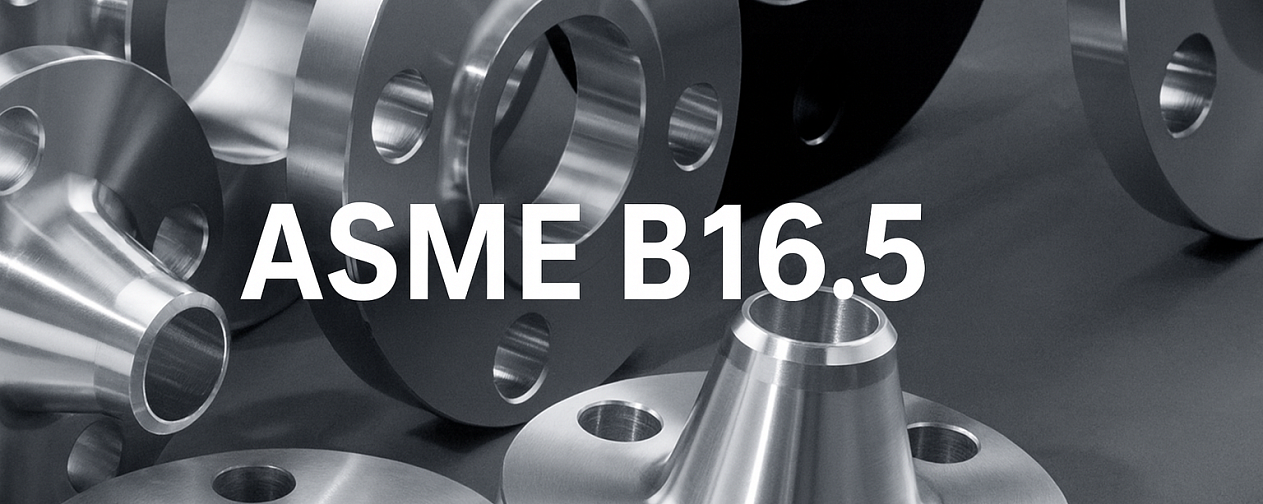
In the world of industrial piping systems, ASME flange standards play a key role in ensuring the safety, reliability, and compatibility of equipment across a wide range of industries. Developed by the American Society of Mechanical Engineers (ASME), these standards provide a comprehensive framework for the design, manufacture, and operation of flanges used in pressure-containing equipment.
Understanding ASME standards is essential for engineers, manufacturers, and end users, as they regulate critical parameters such as material selection, allowable pressures, dimensions, and testing requirements.
Historical Development of ASME Flange Standards
Over the years, ASME standards have evolved, reflecting advancements in materials science, improvements in manufacturing technology, and changing industrial needs. The first versions of these standards appeared in the early 20th century and have been repeatedly revised and updated since then.
One of the most significant is ASME B16.5, which governs pipe flanges and flanged fittings. Over time, it has been refined to ensure that flanges can withstand the extreme conditions of modern industrial operations.
Applications and Industry Importance
Flanges manufactured to ASME standards are widely used in oil and gas production, chemical processing, power generation, and water treatment.
These standards are especially critical in environments where system safety is paramount — such as under high pressure and temperature conditions. For example: in pipeline systems, refineries, and offshore platforms, ASME flanges ensure the safe transport of raw materials; in the chemical industry, they help prevent leaks of corrosive substances. At power plants, they support reliable operation of steam and cooling systems.
Compliance with ASME standards allows companies to enhance safety, reduce downtime, and lower operating costs.
Pressure Classes and Size Ranges in ASME B16.5
ASME B16.5 defines several pressure classes — from Class 150 to Class 2500, each corresponding to specific pressure and temperature limits.
The thickness, bolt size, and overall strength of a flange depend directly on its class. For instance: Class 150 is suitable for low-pressure systems, Class 2500 is used in extremely high-pressure applications.
The standard also includes tables showing how maximum allowable working pressure changes with temperature — helping engineers select flanges that operate safely under given conditions and remain compatible with other system components.
Dimensional and Geometric Standards
ASME B16.5 covers flanges from NPS ½ (15 mm) to NPS 24 (600 mm).
For each size and class, the standard specifies:
-
flange thickness,
-
bolt circle diameter,
-
number and size of bolt holes,
-
type of sealing face.
This ensures interchangeability between manufacturers. It also describes common facing types: Raised Face (RF), Flat Face (FF), and Ring-Type Joint (RTJ).
By adhering to these requirements, manufacturers produce flanges that fit existing systems precisely, reducing compatibility risks and simplifying installation.
Selecting the Right Flange for Service Conditions
When choosing an ASME flange, engineers must consider:
-
operating pressure and temperature,
-
corrosion resistance,
-
mechanical loads,
-
pipeline diameter.
For example, carbon steel is suitable for standard conditions, while stainless steel or special alloys are used in corrosive environments. The facing type depends on the required tightness and gasket type.
Engineers must also account for bolt loading, flange rigidity, and thermal expansion. Careful analysis of these factors and compliance with ASME B16.5 ensure safe and durable connections.
Materials and Design Requirements for ASME Flanges
ASME standards provide precise guidance on material selection, ensuring that flanges can withstand operating stresses and environmental conditions.
Common materials include:
-
Carbon steel (e.g., SA-105)
-
Stainless steel (e.g., SA-182 F316)
-
Alloy steels
The choice depends on pressure, temperature, corrosive exposure, and cost. For instance, carbon steel is used for moderate conditions, while stainless steel is preferred where moisture or chemicals are present.
Design Criteria and Stress Analysis
ASME requires strength and stress analyses to confirm flange integrity under various loads.
Based on the pressure class, engineers determine:
-
flange thickness,
-
hub dimensions,
-
bolt parameters.
Calculations follow ASME Section VIII, Division 1, Appendix 2, which accounts for internal pressure, external forces, thermal effects, and safety factors.
The standards also specify the minimum bolt area needed to prevent leakage.
Testing and Quality Control Requirements
Quality and safety are ensured through rigorous testing and inspection, including:
-
Hydrostatic tests – to verify tightness and pressure resistance;
-
Mechanical tests – to check strength and impact toughness;
-
Non-destructive testing (NDT) – ultrasonic, magnetic particle, and visual inspection.
Manufacturers must implement quality control systems, record test results, and trace production batches. These measures make ASME-certified flanges among the safest and most reliable in the world.
Conclusion
ASME standards play a vital role in ensuring the safety, reliability, and efficiency of piping systems. They establish clear rules for design, material selection, manufacturing, and testing, supporting the production of high-quality components.
The unification of pressure classes, dimensions, and parameters simplifies design, installation, and maintenance. As industry continues to evolve, ASME standards will also advance — remaining the foundation of engineering solutions for piping and pressure equipment.
Source: American Society of Mechanical Engineers (ASME)