
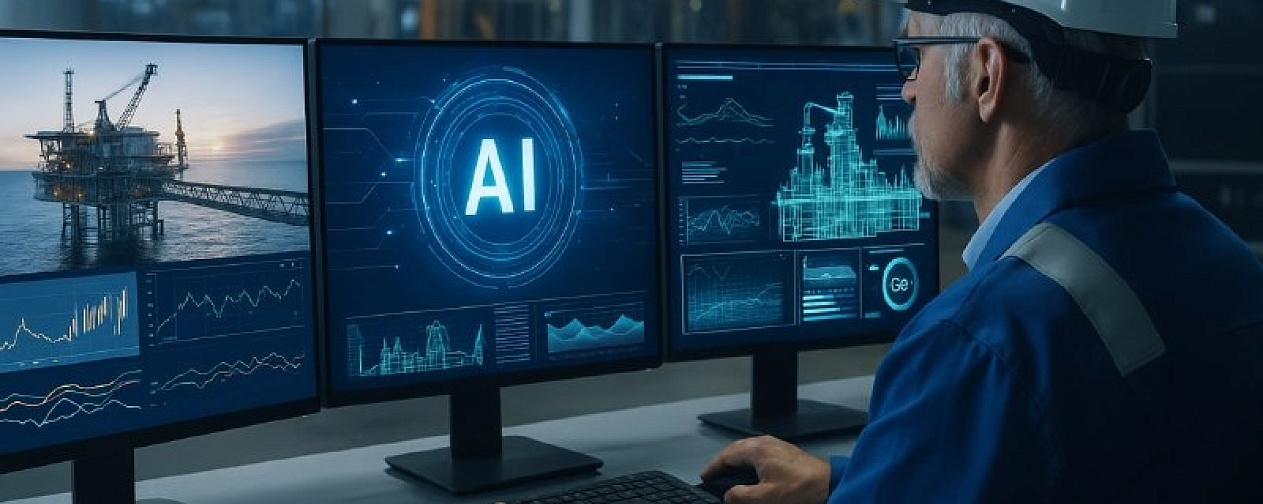
The oil and gas industry is one of the most technologically complex sectors of the global economy. Any error, equipment downtime, or disruption of technological processes can cost companies millions of dollars.
In recent years, companies have rapidly shifted from traditional monitoring and maintenance methods to intelligent digital solutions, where artificial intelligence (AI) and digital twins play a key role.
Studies show that implementing AI can reduce accident rates by 15–25% and lower maintenance costs by up to 30%.
1. How AI Is Integrated into Oil and Gas Production and Quality Control Processes
To make AI beneficial, companies typically go through five key implementation stages.
Stage 1. Equipment Digitalization and Data Collection
The first requirement for implementing AI is high-quality data.
To obtain it, companies install various monitoring systems on equipment and production lines, including:
• vibration and acoustic sensors
• temperature and humidity sensors
• pressure and flow meters
• corrosion monitors
• chemical composition sensors
• high-resolution cameras for visual inspection
• ultrasonic and X-ray NDT systems
All of this forms a continuous, real-time data stream.
Stage 2. Data Centralization and System Integration
The collected data is aggregated into unified digital platforms such as corporate databases or IoT systems.
At this stage, it is critical that the data is synchronized, cleaned of noise, and standardized into a unified format.
Without high-quality data, AI cannot operate effectively.
Stage 3. Building AI Models
Machine learning models are developed and trained on historical and real-time equipment data, including:
• failure prediction models — identifying early signs of abnormal equipment behavior
• defect detection models — analyzing NDT and visual inspection data to detect cracks, corrosion, or delamination
• digital twins — mathematical replicas of real equipment operating in real time
• process optimization models — selecting optimal pressure, temperature, flow rates, and other operating parameters
As new data arrives, these models are continuously refined.
Stage 4. Integrating AI Into Operational Workflows
Once trained, AI models are integrated with real equipment. This allows the system to detect anomalies instantly, notify engineers, automatically create maintenance requests, forecast remaining equipment life, recommend optimal operating modes, and analyze metal condition based on NDT results.
Stage 5. Quality Control and Decision Automation
At the final implementation stage, AI becomes part of the full quality assurance cycle:
• automatic sorting of defective components
• monitoring the condition of welded joints
• identifying corrosion using ultrasonic profiles
• analyzing alloy chemical composition
• verifying compliance with international standards such as ASME, API, and ASTM
In some cases, AI can even recommend optimal alloys or materials if it detects increasing corrosion activity.
2. Predictive Maintenance: When AI Anticipates Failures Before They Occur
Predictive maintenance is one of the most impactful applications of AI in the oil and gas industry.
AI analyzes vibrations of pumps and compressors, pipeline pressure changes, temperature deviations, variations in chemical composition, and NDT inspection results to predict where a failure is likely to occur.
3. Digital Twins: Real-Time Virtual Models of Equipment and Pipelines
A digital twin is a dynamic virtual model of a physical asset.
Updated in real time, it enables companies to predict corrosion, simulate emergency scenarios, choose optimal materials, calculate metal service life, and optimize operating conditions.
For example, a digital twin of a pipeline may identify that increased humidity will accelerate corrosion by 18% and provide recommendations for preventing degradation.
4. AI in Metal and Weld Quality Control
Modern AI technologies can recognize defects on X-ray and ultrasonic images, compare current metal conditions with historical profiles, predict the growth of corrosion pits, and detect abnormal behavior in welded joints.
This significantly increases the accuracy and speed of quality assessment.
5. Economic Impact of AI Implementation
Research shows that AI adoption delivers measurable benefits:
• up to 30% savings in maintenance costs
• a 15–25% reduction in accidents
• a 10–18% increase in production efficiency
• up to 40% extension of metal service life
In a capital-intensive industry like oil and gas, these improvements form a major competitive advantage.
Conclusion
Artificial intelligence is becoming a transformative force across the oil and gas sector.
It enables companies to:
• predict failures
• ensure metal quality
• select optimal materials and alloys
• optimize production and processing
• manage equipment more effectively
• enhance industrial safety
For companies working with metals, equipment, and complex industrial projects, the adoption of AI is not just a trend — it is a new competitive reality.