
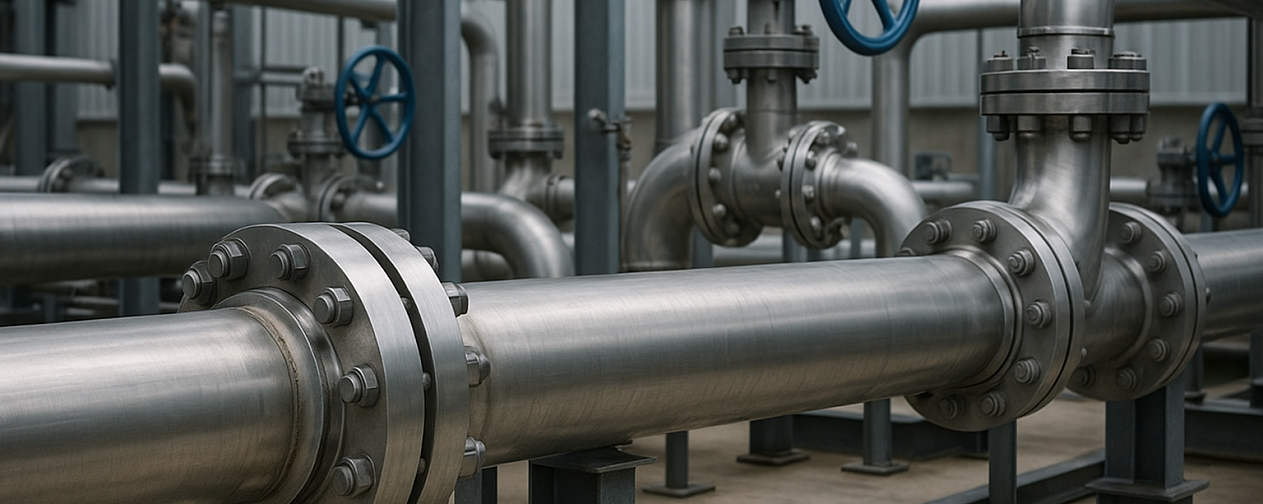
High-pressure piping systems are vital components of modern industrial facilities. They continuously and discreetly transport liquids and gases under extreme pressure, ensuring the operation of power plants, chemical production facilities, the oil and gas sector, metallurgy, and many other industries. However, such power always comes with risks: a single leak or equipment failure can lead to serious accidents, environmental disasters, personnel injuries, and costly downtime. Therefore, proper configuration, operation, and monitoring of high-pressure pipelines are critically important.
Key Terms and Definitions
Understanding basic terminology helps navigate the specifics of system construction and operation.
Pressure Rating
Indicates the maximum pressure a pipeline or its component can withstand under specified conditions. Determines material selection and structural configuration.
NPS (Nominal Pipe Size)
A dimensionless characteristic that denotes the pipe size. It does not always match the actual inner or outer diameter.
Schedule (Wall Thickness)
A designation of the wall thickness of a steel pipe. The higher the Schedule number, the thicker the wall and the higher the allowable pressure.
Material Grade
A set of characteristics of pipe materials: mechanical strength, chemical resistance, and temperature behavior.
Hydrostatic Testing
A method of checking integrity and strength by filling the pipe with water and increasing the pressure.
Nondestructive Testing (NDT)
Ultrasonic, radiographic, and other inspection methods that do not damage the pipe.
Stress Analysis
Engineering calculations of stresses arising from internal pressure, temperature fluctuations, vibrations, and external loads.
Process Physics: Pressure, Stress, and Strength
Pressure is the force acting per unit area. In high-pressure pipelines, this force acts on the inner pipe walls, causing stress.
-
If the stress exceeds the yield strength, the material begins to deform.
-
If the stress exceeds the ultimate tensile strength, the pipe ruptures.
Relationship Between Pressure, Diameter, and Wall Thickness
This relationship is fundamental in engineering calculations. To withstand higher pressure, one must either reduce the pipe diameter or increase wall thickness. This is why high-pressure systems often use pipes with large Schedule values.
Components of a High-Pressure Pipeline
A high-pressure pipeline is a complex system that includes multiple elements, each critical for safety and efficiency.
1. Pipes
The main component through which the working medium is transported. Material selection depends on pressure, temperature, fluid type, and operating conditions.
Common materials:
-
Carbon steel — affordable and widely used but prone to corrosion.
-
Alloy steel — offers increased strength and heat resistance.
-
Stainless steel — corrosion-resistant, suitable for aggressive media.
-
Special alloys (titanium, nickel) — used in extreme conditions.
2. Fittings
Used to connect pipes and change direction or diameter:
-
Elbows — change flow direction (45°, 90°, 180°).
-
Tees — create a branch.
-
Reducers — transition from one diameter to another.
-
Couplings — connect pipes of the same diameter.
3. Valves and Controls
Regulate flow, pressure, and system safety:
-
Gate valves — for complete shut-off/on.
-
Globe valves — for flow regulation.
-
Ball valves — quick on/off with minimal pressure loss.
-
Check valves — prevent backflow.
-
Pressure relief valves (PRV) — protect against overpressure.
4. Flanges
Detachable connections for pipes, valves, and equipment.
Main types:
-
Weld Neck Flanges — welded to the pipe, offering high strength and leak resistance.
-
Slip-On Flanges — slide over the pipe and are welded in place.
-
Threaded Flanges — screw onto the pipe; used for low-pressure systems.
5. Supports and Hangers
Prevent sagging, vibration, and uneven loading. For high-pressure systems, it is crucial to consider:
-
pipe and fluid weight,
-
thermal expansion,
-
dynamic loads,
-
equipment-induced vibrations.
Conclusion
High-pressure piping systems are complex engineering structures that require strict safety compliance, accurate calculations, and regular inspection. Every detail — from wall thickness to flange type — plays a crucial role in preventing accidents and ensuring stable operation.
Proper configuration, appropriate material selection, high-quality installation, and timely inspection are key factors for reliable operation of pipelines working under extreme loads.