
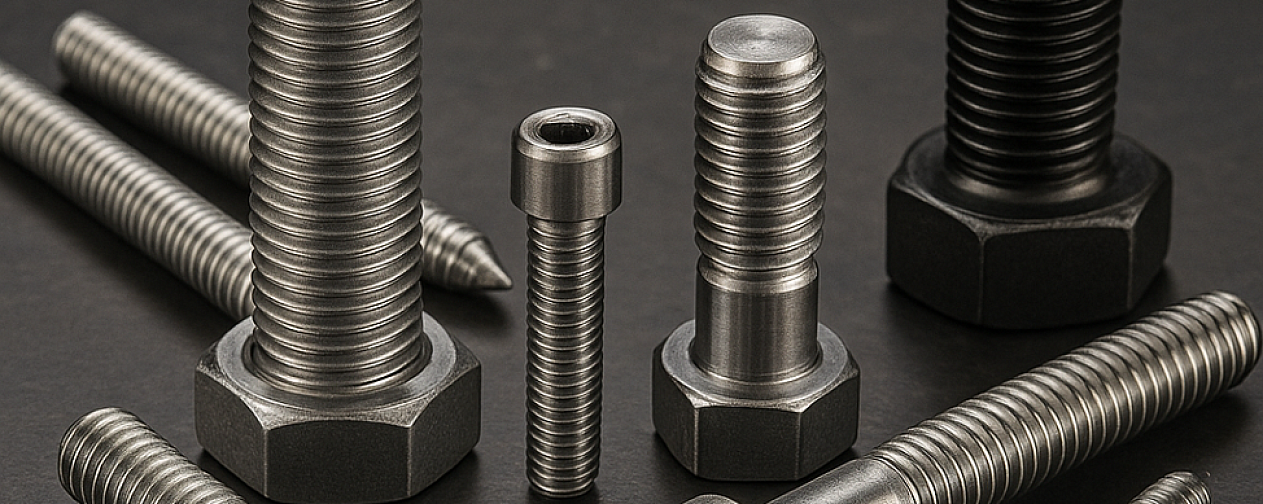
Today, a fastener is more than just a bolt. It is an engineering solution on which the tightness, safety, and service life of an entire piping or vessel system depend. Under conditions of high temperatures, pressure, and aggressive environments, standard fasteners are no longer sufficient — precise calculation, proper material selection, and compliance with international standards are required.
Why has the role of fasteners grown so much?
Modern industries demand equipment that operates under extreme conditions.
At pressures above 250 bar and temperatures over 500 °C, even a slight loss of sealing integrity can lead to costly failures.
That is why a bolt today is a part of the critical safety chain, just like the vessel body or the flange.
Current trends in industrial fasteners
1. New high-strength materials
In 2025, the following fasteners are widely used:
- ASTM A453 Grade 660 — for high-temperature applications, especially in steam generators and turbines.
- Inconel 718 and Alloy X-750 — nickel-based alloys for environments with cyclic thermal loads and aggressive chemicals.
- Duplex steels (F51, F55) — for marine and oil & gas environments, resistant to H₂S and chloride corrosion.
2. Coatings for anti-corrosion protection
- Fluoropolymer (PTFE) and molybdenum-based lubricants are becoming standard for fasteners exposed to seizing or located in hard-to-reach areas.
- They protect threads from galling and simplify disassembly and reassembly, especially after long-term operation in aggressive media.
3. Standards and traceability
Today, industrial fasteners must comply not only with mechanical requirements but also with regulatory standards:
- For high-temperature applications — bolts according to ASME B18.2.1, ASTM B637.
- For pressure — studs made of Alloy 625 according to ASME PCC-1.
- For marine and aggressive chemical environments — coated bolts meeting NACE MR0175 and ISO 15156.
Project documentation often requires marking, a QR code, or engraving indicating the batch number, chemical composition, and certificate of origin (EN 10204 3.1 / 3.2).
Where are industrial fasteners used?
- Flanged joints of pressure vessels use studs with high heat resistance, precise geometry, and controlled tightening force.
- Manholes and inspection covers require fasteners suitable for repeated disassembly.
- Anchor fasteners for securing vessels to foundations must resist vibration and external loads.
- Complex RTJ joints and Spiral Wound gaskets require bolts with precise tolerances and high hardness.
How to choose fasteners in 2025?
- Consider the working environment. Aggressive chemicals, steam, and high pressure all affect material selection.
- Select the correct standard. Bolts A193 B7 and nuts A194 2H are classics for medium conditions, but for high temperatures or corrosive media, Inconel, Hastelloy, and duplex steels are required.
- Request certificates. A reliable supplier will provide EN 10204 3.1, mechanical test reports, and coating certificates.
- Monitor tolerances. Thread geometry, pitch, length, and surface finish affect the reliability of the entire assembly.
Practical example
In 2023, at a chemical plant in Southeast Asia, a flange joint failure occurred due to the use of standard stainless steel A2-70. After switching to Alloy 625 bolts with PTFE coating, the number of failures dropped to zero, and the maintenance interval increased by 18 months.
Conclusion
Today, a fastener is not a consumable, but a strategic element of engineering design. A bolt properly selected for its environment, load, and standard ensures safety, equipment service life, and operational reliability for decades. Investing in the right fasteners is one of the most cost-effective decisions in industrial projects.
Sources: ASME PCC-1: Guidelines for Bolted Flange Joint Assembly (asme.org), ASTM A453 / A193 / B637 standards (astm.org), TWI Global: Bolt Material Selection in Harsh Environments (twi-global.com), NACE MR0175 / ISO 15156 (nace.org), Industry Case Studies from EPC contractors (2023–2024).