
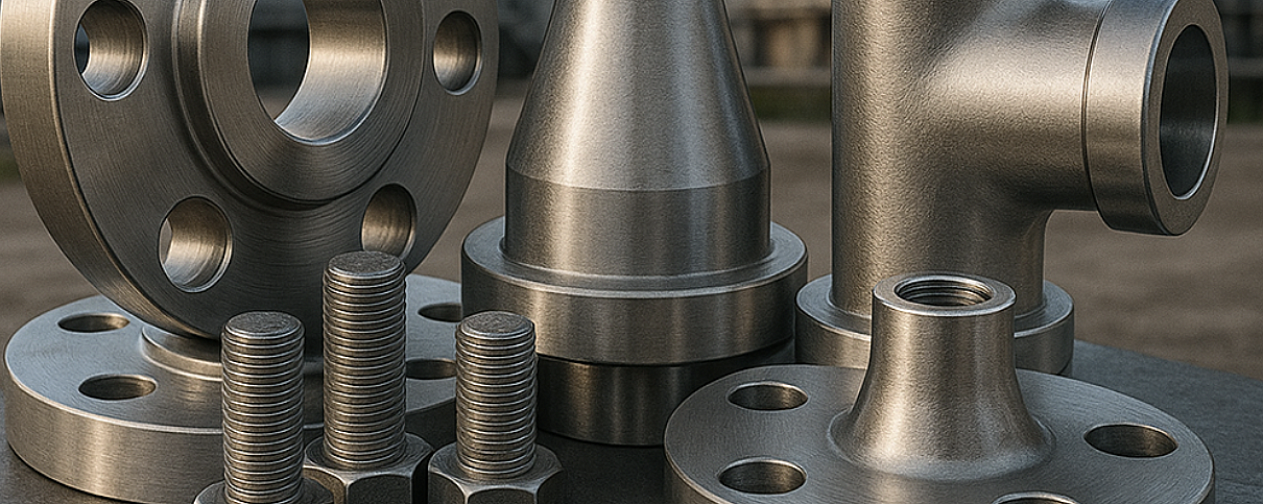
Pressure equipment is the backbone of technological processes in the oil & gas, chemical, and mechanical engineering industries. However, tightness, pressure resistance, and operational reliability depend not only on the vessel body material but also on the components such as flanges, fittings, fasteners, and seals. These “invisible heroes” of construction play a decisive role in the safety and durability of the equipment.
Flanges: Standardization, Tightness, Strength
Flanges are used to connect vessels, pipelines, and other equipment, providing:
-
detachable and leak-tight connections;
-
ease of installation and dismantling;
-
the possibility of regular maintenance.
The most common types are flat, weld neck, threaded, and blind flanges, manufactured from stainless steel, alloyed, and nickel-based materials.
Main standards: ASME B16.5, EN 1092-1, GOST 33259.
Example: In pressure vessels, flanges made of Alloy 625 are used to connect with heat exchangers, withstanding aggressive environments and temperatures up to 600 °C.
Fittings: Precise Pipe Connections in Complex Configurations
Fittings are connecting elements that enable changes in direction, reduction/expansion, or branching of flow inside vessels and piping systems. Common types include:
-
elbows (welded and seamless),
-
tees, reducers, caps,
-
crosses and nipples.
Fittings are manufactured according to ASME B16.9, B16.11, DIN 2615, GOST 17375, and selected based on pressure, temperature, and chemical environment.
Fasteners: Bolts, Studs, Nuts — Small Parts That Matter Most
Fastening elements such as bolts, studs, nuts, and washers connect flanges, covers, supports, and other vessel components. Their reliability is critical under high-pressure conditions. In the chemical and oil & gas industries, commonly used items include:
-
bolts ASTM A193 (B7, B8M),
-
nuts ASTM A194,
-
studs made of nickel alloys (e.g., Inconel 718).
These fasteners provide resistance to corrosion, high temperatures, and mechanical loads.
Additional Elements: Manholes, Nozzles, Supports and Branch Pipes
Pressure equipment also includes:
-
manholes and handholes — for maintenance access;
-
nozzles — for sensors, drains, and pumps;
-
support elements — for reliable installation on foundations;
-
internal elements — baffles, distribution pipes, agitators, etc.
All must comply with ASME Section VIII Div.1/2, with weld inspections, ultrasonic testing (UT), and other nondestructive examinations (NDE).
Conclusion
Flanges, fittings, fasteners, and other components of pressure equipment are not just “auxiliary” details. The quality and precision of these elements determine the performance and safety of the entire system. It is crucial to select components that comply with industry standards (ASME, DIN, GOST) and match the operating conditions — pressure, temperature, and chemical aggressiveness.
For companies in petrochemicals, power, and mechanical engineering, special attention should be paid to suppliers of such components, particularly when it comes to materials made from nickel alloys and stainless steel.