
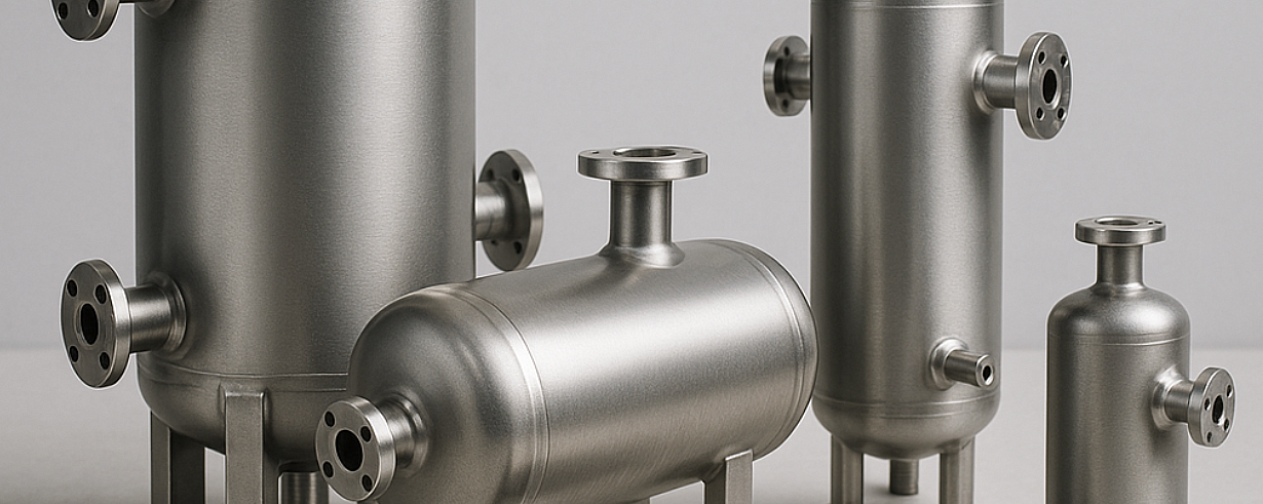
The miniaturization of pressure equipment, such as pressure vessels and tanks, is opening new opportunities in mechanical engineering. It enables the creation of compact, efficient, and mobile systems for the oil and gas, chemical, aerospace, and medical industries. In conditions of limited resources and space, miniature designs become a key solution, reducing costs and simplifying logistics. ASME standards, particularly the ASME Boiler & Pressure Vessel Code (BPVC), play a vital role in ensuring the safety and reliability of such systems.
Why is Miniaturization Needed in Mechanical Engineering?
Context and relevance: In today’s world, where resources are limited and demands for mobility and compactness are increasing, equipment miniaturization is a priority. This is especially relevant for projects requiring high efficiency in constrained spaces, such as mobile processing units, medical equipment, or aerospace systems.
Applications: Miniature pressure vessels and tanks are used in portable gas systems, compact chemical reactors, and medical devices such as oxygen delivery systems. Their compactness reduces material costs and simplifies transportation.
Environmental aspect: Miniaturization helps reduce the carbon footprint by lowering material and energy consumption. For example, compact systems can cut energy use by 10–20% compared to traditional equipment.
How Do ASME Standards Support Miniaturization?
Innovations Driving Miniaturization
Real-World Applications
Challenges of Miniaturization
Conclusion
The miniaturization of pressure equipment, supported by ASME standards, is opening new horizons for mechanical engineering, combining compactness with reliability. For engineers and manufacturers, studying these standards and innovations is key to creating competitive solutions. Events such as the Advanced Manufacturing Expo provide a platform to exchange knowledge and explore the latest advancements shaping the future of the industry.
Miniaturization not only addresses current challenges but also sets the course for sustainable and efficient engineering.
Source: Mechanical Engineering Magazine (asme.org), Journal of Manufacturing Processes (sciencedirect.com), Advanced Manufacturing Expo (advancedmanufacturing.org)
Why is Miniaturization Needed in Mechanical Engineering?
Context and relevance: In today’s world, where resources are limited and demands for mobility and compactness are increasing, equipment miniaturization is a priority. This is especially relevant for projects requiring high efficiency in constrained spaces, such as mobile processing units, medical equipment, or aerospace systems.
Applications: Miniature pressure vessels and tanks are used in portable gas systems, compact chemical reactors, and medical devices such as oxygen delivery systems. Their compactness reduces material costs and simplifies transportation.
Environmental aspect: Miniaturization helps reduce the carbon footprint by lowering material and energy consumption. For example, compact systems can cut energy use by 10–20% compared to traditional equipment.
How Do ASME Standards Support Miniaturization?
- Safety of compact designs: ASME Section VIII, Divisions 1 and 2, sets requirements for the design of miniature pressure vessels, including strength and high-pressure resistance. This is critical for compact systems where even small defects can have severe consequences.
- Welding and materials: ASME Section IX regulates welding procedures for miniature designs, ensuring reliable joints in tight spaces. High-strength materials such as titanium alloys and stainless steel are used for corrosion resistance and durability.
- Nondestructive testing (NDT): ASME Section V defines testing methods, including micro-radiography and ultrasonic inspection, adapted for compact systems to detect defects in miniature vessels.
- Global certification: ASME certification simplifies the introduction of miniature equipment into international markets, including aerospace and medical industries, where safety standards are mandatory.
Innovations Driving Miniaturization
- Microchannel designs: New pressure vessels with microchannel structures improve heat exchange and compactness, ideal for mobile chemical and medical systems.
- Additive manufacturing (3D printing): 3D printing enables complex geometries, reducing weight and material use by 15–25%. ASME is developing standards for certifying 3D-printed equipment.
- Lightweight materials: Composites and nanostructured alloys increase strength while lowering weight, especially important for aerospace.
- Digital monitoring systems: IoT sensors integrated into compact systems monitor pressure, temperature, and integrity in real time, preventing up to 90% of potential failures.
Real-World Applications
- Aerospace (USA): ASME-certified miniature pressure vessels are used in satellite fuel systems, ensuring compactness and reliability in space.
- Medical devices (Japan): Compact oxygen storage tanks in portable systems meet ASME standards, providing safety and mobility for patients.
- Mobile units (Australia): Miniature chemical reactors are deployed in remote oil and gas projects, reducing transport and installation costs.
Challenges of Miniaturization
- Technical complexity: Designing miniature vessels requires extreme precision, as even minor defects can cause failures. ASME standards help minimize these risks.
- Development costs: Creating and certifying compact systems under ASME requires significant investment, though long-term benefits outweigh expenses.
- Material limitations: Miniaturization demands extraordinary material strength and resistance, which may limit options and increase costs.
Conclusion
The miniaturization of pressure equipment, supported by ASME standards, is opening new horizons for mechanical engineering, combining compactness with reliability. For engineers and manufacturers, studying these standards and innovations is key to creating competitive solutions. Events such as the Advanced Manufacturing Expo provide a platform to exchange knowledge and explore the latest advancements shaping the future of the industry.
Miniaturization not only addresses current challenges but also sets the course for sustainable and efficient engineering.
Source: Mechanical Engineering Magazine (asme.org), Journal of Manufacturing Processes (sciencedirect.com), Advanced Manufacturing Expo (advancedmanufacturing.org)