
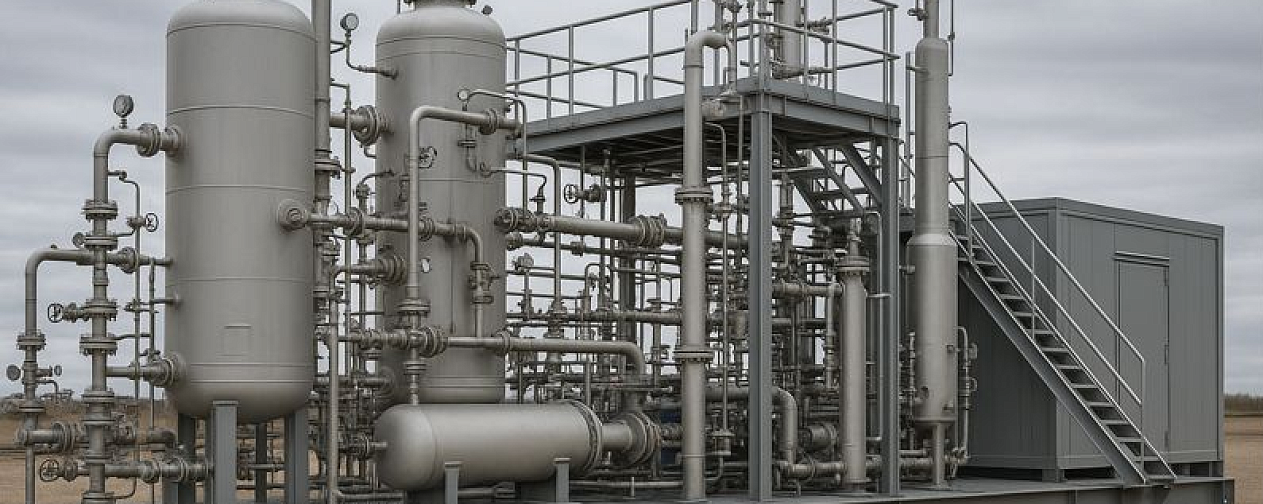
Modular units in the oil and gas industry represent a compromise between traditional stick-built construction and the delivery of standalone equipment. A facility is designed in advance as a set of functional blocks with fixed connection boundaries, assembled and tested to the greatest extent possible at the fabrication yard, and then transported to site for heavy-lift installation, interconnection, and commissioning. This approach is valued for schedule and quality predictability, especially for remote sites and projects with tight seasonal construction windows.
What Is Meant by a Modular Unit
A modular unit is a process complex divided into functional blocks that:
-
are designed as autonomous units with clearly defined battery limits,
-
are fabricated and assembled at a factory (or a pre-assembly yard),
-
undergo factory acceptance testing (FAT),
-
are delivered to site and connected via predefined interfaces.
In practice, modularization can vary in “depth”:
-
Skid-mounted: equipment on a skid frame (pump packages, filters, chemical dosing).
-
Containerized: container solutions (instrumentation & control, analyzer shelters, electrical).
-
Pre-assembled modules: larger blocks with maintenance platforms.
-
Megamodules: very large modules (major gas/LNG projects) requiring specialized logistics and heavy installation.
Application of Modular Solutions
Modularization is most effective where the construction window is short (seasonality, climate), the site is remote and resources are limited, and the cost of downtime and delays is high.
Modular units are used for production and field processing facilities, transportation infrastructure, and processing/refinery support systems, including oil treatment (separation, heating, demulsification, dehydration/desalting), gas treatment (filtration/separation, H₂S/CO₂ removal), water treatment and waterflood/injection systems (filtration, deaeration, chemical dosing), pipelines and stations (pressure reduction/heating skids, pig launcher/receiver systems, metering and measurement units), as well as electrical and instrumentation/control infrastructure.
Engineering Advantages
First, the volume of field work is reduced. Fabrication-yard conditions provide more consistent weld quality, assembly, tagging/labeling, cable routing, and installation of instrumentation and control. This lowers rework on site and improves the predictability of start-up.
Second, the schedule becomes more parallel. While site preparation, foundations, and offsite utilities are executed in the field, module fabrication and outfitting proceed in parallel at the yard. With properly frozen interfaces, this shortens the project’s critical path.
Third, “start-up readiness” improves due to factory testing. During FAT, not only tightness and electrical checks are performed, but also signal integrity, protections, control logic, and interlocks. The more issues detected and resolved before shipment, the lower the risk of prolonged commissioning on site.
Modular Project Architecture: Key Engineering Decisions
Modularization requires a different level of rigor in layout and documentation:
-
the layout must account for transportation constraints (overall dimensions, weight, axle loads, packing/preservation requirements, loading/transfer conditions, and allowable dynamic loads during transport),
-
the module structure is designed as a transport and installation unit (frame stiffness, lifting points, allowable deflections, local stress concentrations, and vibration robustness for rotating equipment),
-
all tie-in points must be defined in advance with 3D coordinates and tolerances to minimize on-site fit-up.
A separate set of requirements concerns operability and maintainability. A module may be process-correct but difficult to maintain due to dense arrangement. Therefore, at the 3D stage, checks are performed for access to valves and instrumentation, service envelopes for filters, pumps, and exchangers, feasibility of component removal, placement of drip trays and drains, and safe access routes.
Quality and Verification: The Role of FAT and SAT
For modular units, it is critical to distinguish:
-
FAT (Factory Acceptance Test): verification of assembly, tightness, electrical systems, instrumentation, control logic, and—partly—process scenarios (via test stand/emulation).
-
SAT (Site Acceptance Test): verification after installation and hook-up on site, integration with external systems, and confirmation of operability as part of the overall facility.
Conclusion
Modular units have become one of the baseline delivery models for oil and gas facilities. For standard process packages and infrastructure, modularization is effectively the default, because fabrication-yard assembly and pre-testing reduce site work and improve start-up predictability.
At the level of large projects, modularization is applied selectively, but increasingly as a management tool for schedule, HSE, and quality—especially for remote sites and projects with seasonal constraints.
Overall, the industry views modularization not as an “alternative to construction,” but as a practical way to bring facilities to stable operation faster and more reliably, provided that interfaces, logistics, and the testing program are properly engineered.