
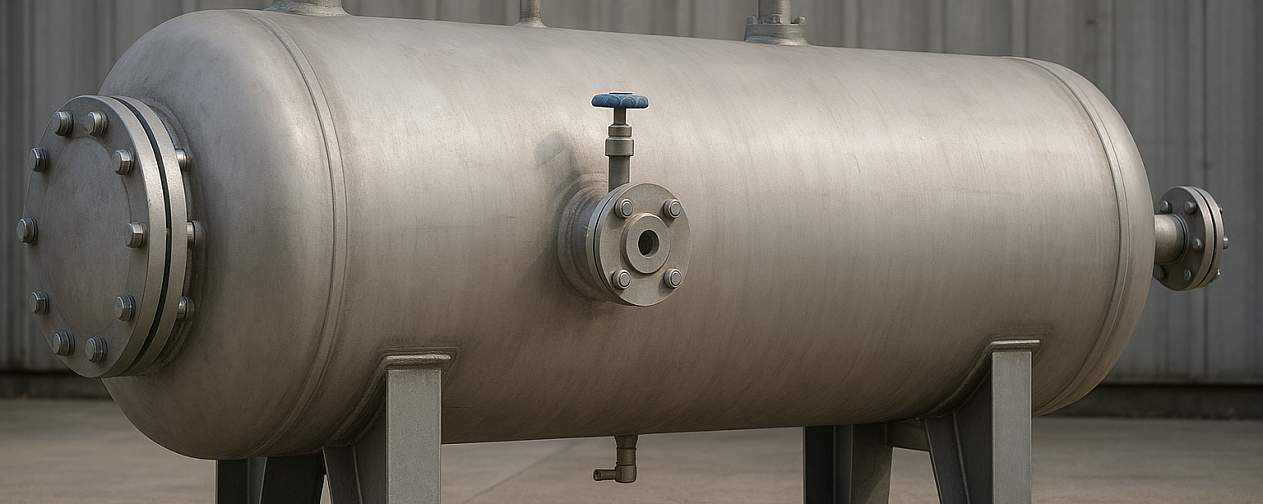
In the oil and gas industry, pressure vessels are critical components that ensure the safe containment of liquids or gases under high pressure and often in harsh environmental conditions.
By construction, pressure vessels are classified as cylindrical, spherical, and conical; by purpose — as process vessels(reactors, columns), storage tanks, heat exchangers, and cylinders; and by material — metallic, composite (for example, Type 4 with carbon fiber), and polymeric.
Engineering such components requires a careful balance between safety, efficiency, and strict compliance with regulatory standards.
Theory of Pressure Vessel Engineering
The foundation of pressure vessel engineering lies in the scientific theory that explains how materials respond to internal and external stresses. The primary goal of engineers is to ensure that the vessel walls can withstand the operating pressure without failure.
The engineering process follows strict regulations such as the ASME Boiler and Pressure Vessel Code (BPVC).
Allowable stresses are determined based on the material properties and operating conditions, including an appropriate safety margin. Factors such as fatigue cracking due to cyclic loading, stress corrosion cracking, plastic deformation, and elastic deformation are also taken into account.
Adhering to these principles minimizes the likelihood of catastrophic failures, thereby enhancing safety and preventing financial losses.
How to Calculate a Pressure Vessel Project
Pressure vessel engineering involves a systematic approach that combines engineering formulas, material science, and professional expertise.
- Defining engineering parameters: Determine the maximum operating pressure, temperature range, fluid properties, and vessel dimensions.
- Material selection: Choose materials with adequate strength, ductility, and corrosion resistance for the intended environment.
- Wall thickness calculation: Using established formulas, calculate the minimum allowable wall thickness based on pressure, radius, allowable stress, and weld efficiency.
- Stress analysis: Compute circumferential, longitudinal, and radial stresses, ensuring they remain below allowable limits.
- Corrosion and manufacturing allowances: Add extra thickness to account for corrosion over time and production tolerances.
- Standards verification: Ensure compliance with ASME BPVC and API 510 codes.
Key Requirements for Pressure Vessel Engineering
- Structural integrity: The vessel must withstand operating pressures and temperatures without deformation or failure.
- Safety factor: Typically ranges from 1.5 to 4 to account for uncertainties in loading conditions.
- Compliance with international standards: Such as ASME BPVC and API 510, governing materials, welding, testing, and inspection.
- Resistance to corrosion and fatigue: Essential for vessels handling corrosive fluids and cyclic pressures.
- Ease of maintenance: The vessel must allow convenient access for inspection and repair.
Meeting these requirements ensures operational safety, reduces risks, and minimizes equipment downtime.
Pressure Vessel Operating Conditions
When engineering a pressure vessel, all operational and environmental factors must be considered:
- Operating and test pressure
- Temperature range (high and low extremes)
- Fluid characteristics — toxicity, corrosiveness, phase (liquid or gas)
- External influences — climate, vibration, seismic activity
- Pressure cycles — frequency and amplitude of pressure fluctuations affect fatigue life
- Geometry and dimensions — the vessel’s shape determines stress distribution
A comprehensive analysis of these factors allows engineers to achieve an optimal balance of safety, durability, and efficiency.