
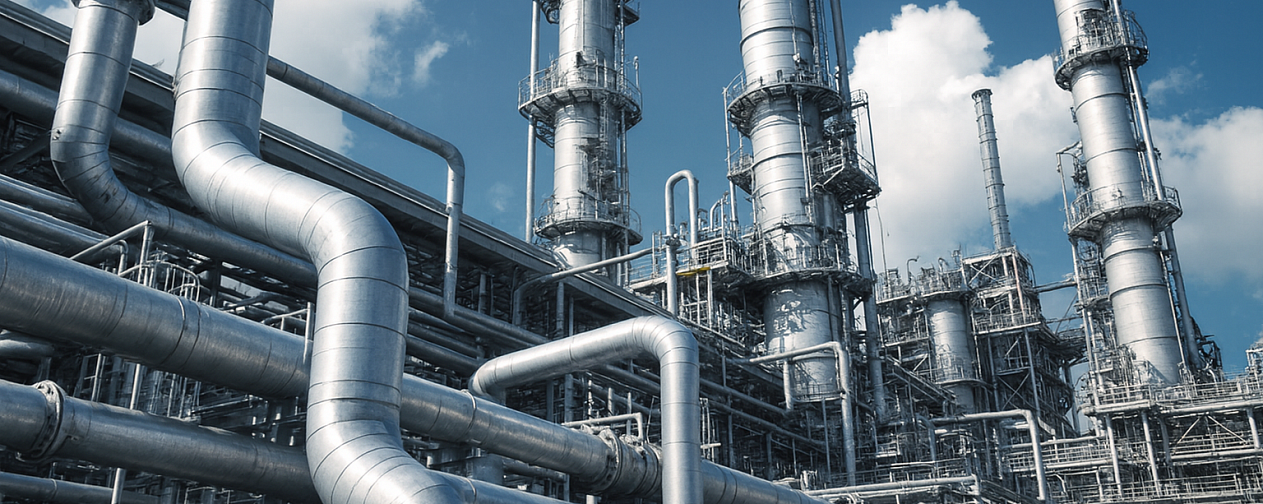
In the vast network of oil and gas pipelines stretching for tens of thousands of kilometers, there is one critically important component — the pipeline connectors. They link different sections of pipelines, perform over 80% of energy transport functions, and their reliability directly determines the safety and efficiency of the entire energy infrastructure.
Classification of Fittings: The Rivalry Between Seamless and Welded
1. Seamless Fittings
Seamless fittings are manufactured by piercing solid steel billets into hollow tubes. Thanks to the absence of welds, they act as “safety guardians” under high-pressure conditions. In production, round billets are heated to around 1200 °C, pierced into hollow tubes on a piercing mill, and then subjected to cold drawing and hot rolling for precise dimensional control.
Advantages: Seamless fittings have exceptional strength — they can withstand pressures exceeding 100 MPa. They are therefore used in shale gas wellhead installations and deep-sea pipelines. The absence of weld seams minimizes stress concentration points, providing superior corrosion resistance when transporting aggressive media such as hydrogen sulfide (H₂S).
Disadvantages: The complex manufacturing process makes them more expensive. In addition, there are size limitations — producing very large-diameter fittings is challenging.
2. Welded Fittings
Welded fittings are produced by rolling steel plates into tubes and joining them by butt welding. The use of fully automatic submerged arc welding (SAW) ensures weld strength exceeding 95% of the base metal.
Advantages: The main advantage of welded fittings is the ability to produce large-diameter components. Material utilization efficiency is 30% higher than in seamless fittings, which offers significant cost savings for long-distance pipelines.
Key Processes: Butt welding is the core operation in manufacturing welded fittings. With precise edge machining and automated equipment, strong and leak-proof joints are achieved. Induction bending technology using medium-frequency heating allows pipe diameter expansion and eliminates wall-thickness irregularities in large-diameter fittings.
Main Production Processes: The Art of Bending
1. Hot Bending
The induction bending process uses eddy currents generated by an electromagnetic coil to locally heat steel to 800–1100 °C. At this temperature, the pipe bends precisely under mechanical force.
Advantages: Compared to traditional hot bending, the induction method ensures higher accuracy and wall-thickness uniformity: thickness reduction ≤ 8% (vs. up to 12% in the conventional method), and angle deviation only ± 0.5° (vs. ± 2°). Productivity is also higher: 5–8 bent pipes per hour — 2–3 times faster than conventional techniques.
Applications: The method is widely used in subsea pipeline construction. Induction-bent fittings can withstand underwater pressure and ocean currents, ensuring reliable gas transport.
2. Advanced Induction Bending
The modern version combines laser measurement and PLC (programmable logic controller) systems into an intelligent control loop. It adjusts bending speed and angle in real time, providing precise geometric control.
Industry Trend: Prefabrication
The prefabrication model involves pre-assembling fittings, valves, and instruments into modular blocks such as “valve groups” or “metering modules.” This approach has transformed traditional construction methods.
Advantages: On-site installation becomes much faster — pipes can be assembled without prolonged welding and adjustment, improving installation efficiency by over 50%. Factory production ensures consistent quality and simplifies inspection.
Conclusion
From precision butt welding to flawless induction-formed bends, oil and gas pipeline fittings are rapidly evolving toward smarter and more efficient solutions. Every technological advancement in these “steel joints” contributes to the energy security of the entire world.
Source: Chronicle Journal – AB Newswire Industry Reports